A little help for your next chapter
Nobody really prepares you for becoming a manager.
One day, you’re great at your job. The next, you’re responsible for people, difficult conversations and decisions nobody taught you how to make.
I wrote this guide to help you find your feet, one real situation at a time.
29 chapters Real stories Practical guidance

For the things you don’t say out loud
Does this sound familiar?
You care about doing this well. But some days, you’re figuring it all out as you go.
You don’t have to have all the answers to take the next step.
- “I feel like a fraud in this job.”p. 13
- “One of them wanted my job.”p. 34
- “I keep taking the work back off them.”p. 85
- “I am dreading a conversation this week.”p. 125
- “I never switch off any more.”p. 77

263-page digital book · Instant PDF download
Practical help for real situations
The guide I wish I had.
When I first became a manager, I thought being good at my job meant I would know how to lead people. I didn’t.
I needed someone to help me work out what to do, what to say and what to stop doing. That’s what I’ve put into this book.
- Find the situation you’re in. Start with the chapter you need today. There’s no need to read in order.
- Find the words to say. Real conversation scripts for feedback, delegation and the discussions you’ve been putting off.
- Leave with something you can do. Practical actions to try before Friday, alongside real stories and 34 original illustrations.
US$9.99 · Instant PDF download · Yours to keep

25+ years in the corporate world.
Still learning. Still sharing.
A note from Julee
Hi, I’m Julee.
I’ve spent over 25 years in the corporate world, and I’ve learned that becoming a manager can be one of the most exciting and overwhelming transitions in your career.
You’re suddenly expected to lead people, handle difficult conversations and make decisions that affect others. And sometimes, you just wish someone would tell you what to do next.
That’s why I wrote this guide.
Not to teach you how to become a perfect manager, but to share the lessons, mistakes and practical advice I wish I’d known earlier.
With love,
Julee
A few pages, just for you
Take a peek inside.
Real pages from the guide. A story to recognise yourself in, words to borrow and a next step you can actually take.
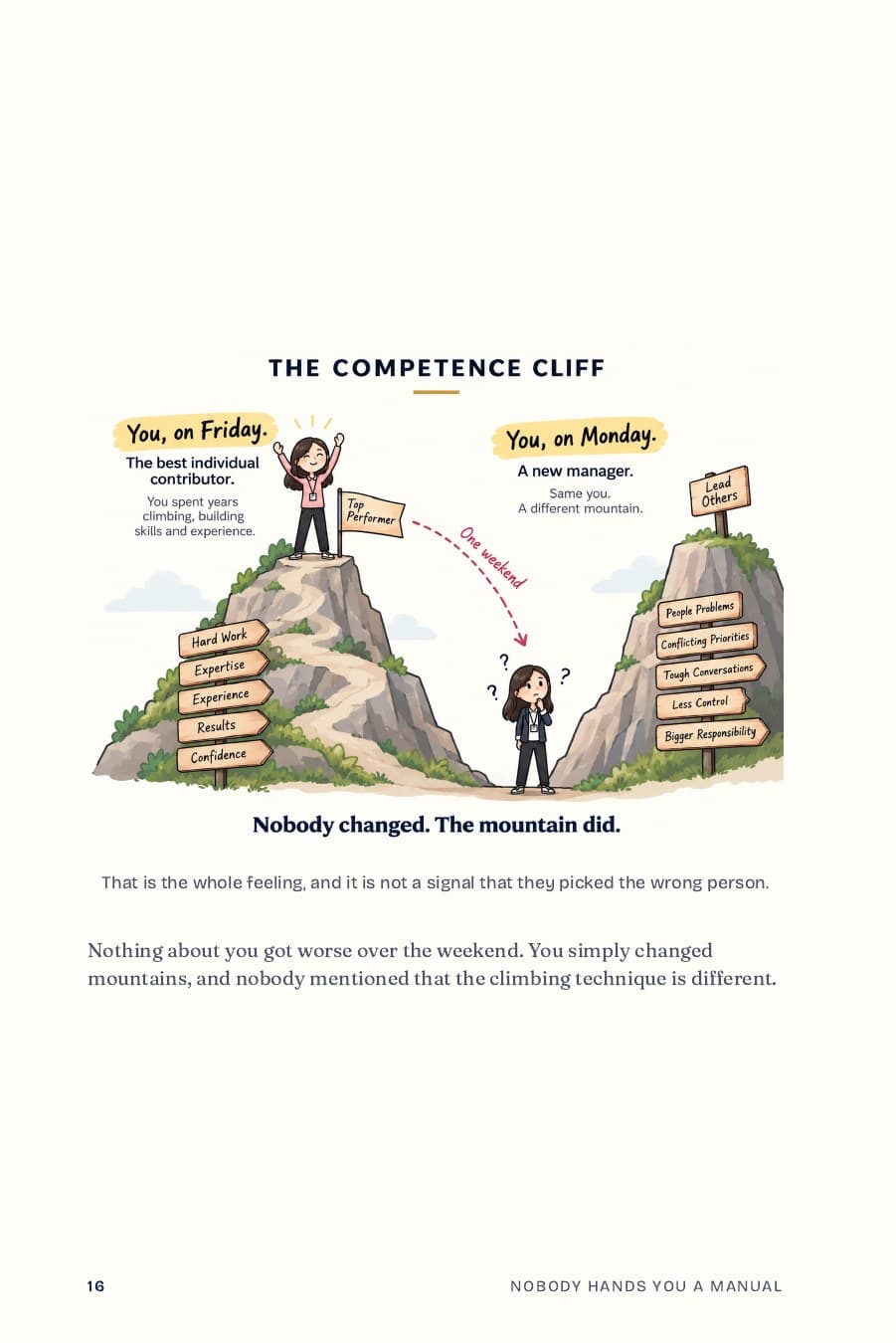

Choose a page below to read it full size. Swipe or use the arrows to explore.
Explore all seven parts of the guide
- 01
Survive your first weeks
Your first days, the team that used to be your peers, and the meeting that quietly decides what they think of you.
- 02
Avoid the five traps
Rescuing, bluffing, pleasing, cloning, never switching off. Every one of them feels like good management while you are doing it.
- 03
Learn to let go
Eighty per cent is enough. Say what done looks like, hand it over properly, and let them get it wrong.
- 04
Have the conversations
Feedback small and often, the one you have been dreading, what to do when it does not improve, and two people who cannot stand each other.
- 05
Manage up and across
Influence without authority, translating what leadership hands you, and making sure your team is actually seen.
- 06
Manage yourself
Your mood is the climate your team works in, and nobody is checking whether you are all right.
- 07
Become the manager people remember
The things people still repeat years after you have gone, and what quietly leaves with you.
Find the situation you’re facing this week
- “I feel like a fraud in this job.”p. 13
- “I think I lost my team in week one.”p. 19
- “One of them wanted my job.”p. 34
- “Somebody new starts on Monday.”p. 42
- “I am not the expert on this team.”p. 58
- “I cannot push back on my boss.”p. 66
- “They never do it the way I would.”p. 71
- “I never switch off any more.”p. 77
- “I keep taking the work back off them.”p. 85
- “Nobody tells me if I am doing this well.”p. 115
- “I am dreading a conversation this week.”p. 125
- “Somebody is not improving and I am stuck.”p. 142
- “Two of my people cannot stand each other.”p. 163
- “We keep agreeing things and then not doing them.”p. 172
- “Somebody asked me for a raise.”p. 197
Something you can use on Tuesday
Sometimes, you just need the words.
You already know you should give feedback.
But how do you actually start the conversation?
You already know you should delegate.
But what do you say when they do not do it the way you would?
You already know you should not avoid conflict.
But what do you say when two people on your team cannot stand each other?
The scripts are written out, ready to make your own. Take them into your next one-to-one.

How the book opens
The day I nearly drowned under a raft.
Our raft flipped. Everyone fell in. I went under.
I swam up for air and hit something. The bottom of the raft. No air pocket. Nothing.
I pushed up again. Nothing.
This is it. I am going to die here.
Then I remembered something my uncle used to say. If what you are doing is not working, do something different.
So I swam down. Everything in me wanted to go up.
And suddenly I was out. I could breathe.
You got promoted because you worked hard, solved the problems yourself, and had the answers. Then you become a manager, and those same things start working against you. Longer hours, a less capable team. More answers, and more questions.
You are swimming up into the bottom of the raft.
Not harder.
Different.
Every chapter of this book is a version of that one instruction.
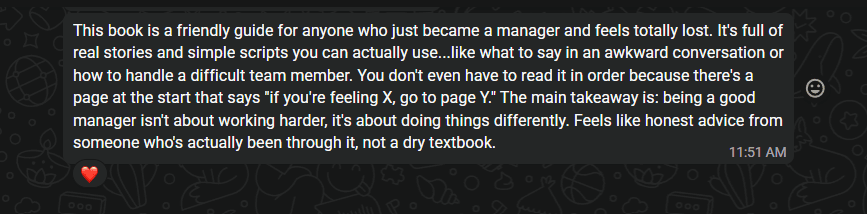
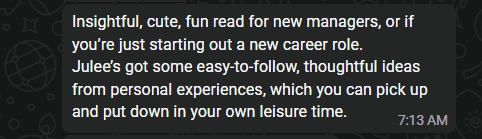
From the first people who read it
What early readers said back.
Sent to me privately, and shared here with their permission.

For wherever you are right now
You don’t have to figure it all out on your own.
You don’t need to become a perfect manager overnight. Start with the situation in front of you. I hope this guide makes that next step feel a little easier.
- 29 real management situations
- Conversation scripts and practical actions
- 34 original illustrations
- 263 pages
The complete guide
Instant PDF download
Read on your phone, tablet or computer. Yours to keep.
A little help for your next chapter.
Before you begin
A few things you
might be wondering.
What format is it in?
A PDF you can read on any device. The scripts and checklists sit inside it, laid out so you can take them straight into your own one-to-ones.
Is this only for corporate jobs?
No. It applies anywhere you are suddenly responsible for people, whether that is a corporate team, a small business, or a nonprofit.
I have been managing for a couple of years. Is it still for me?
Probably, yes. The first part is about your first weeks, but most of the book is about things that do not go away: the conversation you keep putting off, the person who is not improving, the work you cannot seem to hand over.
Should I know all this already?
Most new managers think so, which is exactly why nobody asks. Almost nobody is actually taught this. The book assumes you were not, and it never makes you feel behind for it.
I am not naturally good with people. Will it still work?
Yes. Nothing in it asks you to change your personality. It gives you the words and the steps, and quiet managers use them just as well as confident ones do.
Put the words into practice
Read it here. Rehearse it with JuleeTalk.
The JuleeTalk App gives you a space to practise the conversations in the guide. Start with the free, 60-second demo. The full app is in early access.
Try the free app demo